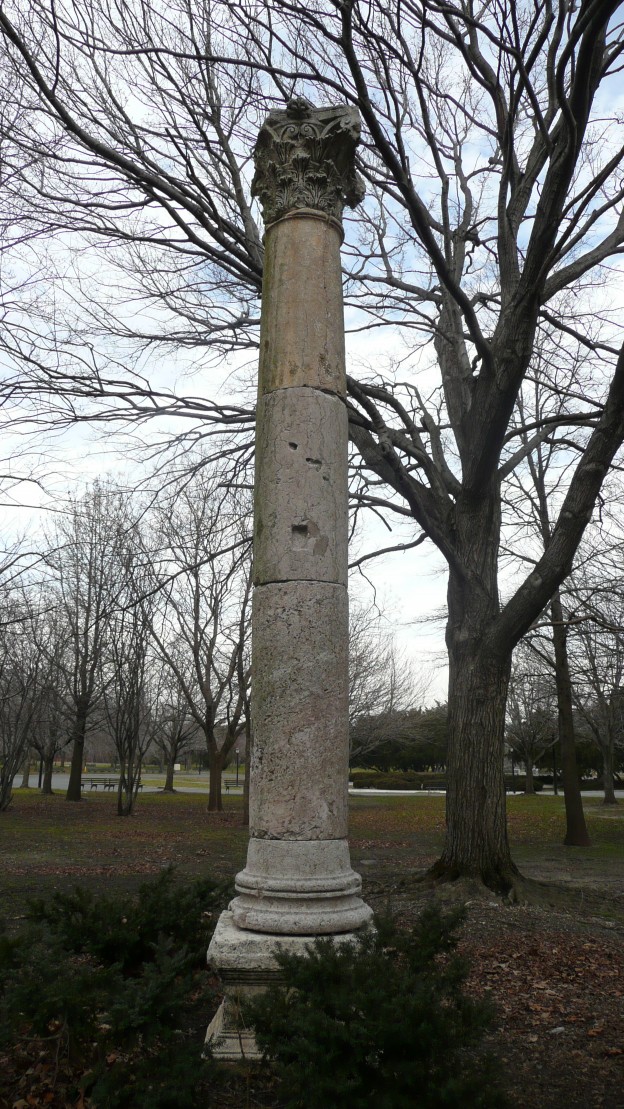

The Column of Jerash, January 2013, looking North. (J. Simard)
The Column of Jerash, now in Flushing Meadows Queens, came from the Temple of Artemis in the ancient city of Jerash. The column is composed of a Corinthian capital and three drums, located a top an attic base. The column rests on a modern concrete pediment that is sunk into the ground. The three drums of the column’s shaft are unexceptional; the middle block has a shallow but clear rectangular cut, which you can see in this picture (click on the picture to enlarge the image). The highest drum sharply tapers to the Corinthian capital.

Corinthian Capital, Detail, (J. Simard)
The Corinthian capital is composed of two tiers of acanthus; two helices face each above the acanthus. (Click on the image for more detail.) At each corner, a volute springs forth. There is a boss with a fleuron that is located at the center of the abacus on each side. The capital is in reasonably good condition. The southwestern corner volute (visible here on the left) has been almost entirely lost (although the capital seems to have been in this condition when it was sent to the World’s Fair). The southeastern corner is also damaged. The northeastern and northwestern corner volutes are complete.

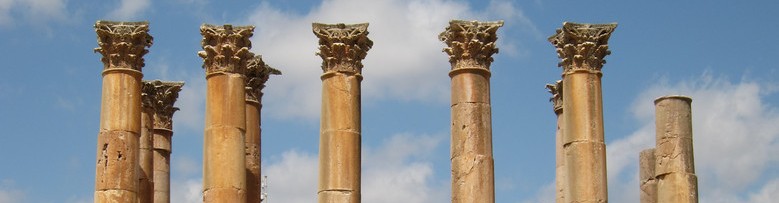
Jerash – Temple of Artemis, (Sean
Leatherbury/Manar
al-Athar)
At first glance, the image appears to be very similar to the columns still standing at the Column of Jerash (which you can see on the left); however, looks can be and are, in this case, deceiving. A review of the excavation publications and the photographs of the Temple of Artemis taken by Yale University excavators in the 1920s and 1930s and photographs taken in the 1940s by Matson Photograph Service demonstrate that the Column of Jerash now in Queens is missing several of its drums and is shorter than any of the recorded heights of the columns still standing at the Temple of Artemis. Photographs of the columns in situ in Jerash typically show five drums not three drums, suggesting that this column is shorter than it should be. 1 The photographs of 1964-5 and today both show the three drums, so there has been no change in the column’s height since it was erected. Another photograph from the Yale University excavations, dated October 21, 1930 shows that the drums with rectangular cuts are located in the lowest position in at least three of the columns, not in the middle drums of these columns. 2 Therefore, this suggests that the column was sent with an incorrect number of drums.

Temple of Artemis, Jerash, Matson Photo Service
(Library of Congress)

Jerash, pillars of Temple of Artemis, Matson Photo Service (Library of Congress)
1946 photographs, now in the Library of Congress, show the standing columns in situ. 3 Of particular interest is the second column in the second row (behind the man standing between the first column of the first and second rows in the far left image). This column has a rectangular cut, nearly identical to that in the Column of Jerash now in Queens. However, this cut is in the first drum of the column, not in the middle. Another photograph (below) also confirms the placement of the rectangular cut on the first drum of the shaft of another column in the second row. 4
Archival materials from the World’s Fair Corporation record the height as 30 feet (or 9.14 m). 5 According to the excavation report, the shafts of the columns varied in height from 13.07 m to 13.25 m, making the range in feet from 42 feet 10 9/16 inches to almost 43 feet 6 inches. 6
All of this suggests that the column was not originally from the Temple of Artemis, but might have been from another location in Jerash.
- Yale U. Art Gallery, negative number, gerasa~b75~01 B-75, November 1, 1930, title: Colonnade, South of Temple of Artemis, Room A-43, sub A-43; gerasa-b8~01 B-8, October 15, 1930, title: the Temple of Artemis, South Side, Northeast. ↩
- Yale U. Art Gallery, negative number, gerasa-b20~01 b-20, title: uncleared portico. ↩
- Access the far left photograph and further information here. ↩
- Access the near left photograph and further information here. ↩
- World’s Fair, Archive Box 278, held in the NYPL. ↩
- The shafts of the columns varied; the difference in height was made up by using capitals of varying heights, see Fischer, Temple of Artemis, in Kraeling 1938, 135. ↩

